How to Choose a Microprocessor
Table of Contents
from the July 1978 issue of Byte magazine
by Lou Frenzel - Heath Company - Benton Harbor Ml 49022
All personal and hobby computers are microprocessor based. That is, they use a single processor integrated circuit chip. One of the most important decisions you will ever make in purchasing a personal computer is choosing the type of microprocessor. The semiconductor manufacturers have provided computer designers with a wide range of microprocessing units having varying degrees of power and sophistication. As a result, there are at least a half dozen different processors available in hobby computers. This wide variety of products makes your choice somewhat flexible, or at least it seems that way. In reality, having so many processor styles to choose from, your decision becomes much tougher. If you are a beginner, it may be particularly difficult to make an intelligent choice. The purpose of this article is to provide you with some guidelines in making this important decision. The emphasis is on how to choose the best microprocessor for you when purchasing a personal computer.
What’s Available
Below is a list of all of the available microprocessor architectures and their primary manufacturers.
Intel 8080, 8085, 8048, 8086
Motorola 6800
MOS Technology 6502
Zilog Z-80, Z8000
Signetics 2650
RCA 1802
Fairchild F8, 9440
MOSTEK 3870
Intersil 6100
Texas Instruments 9900
National Semiconductor SC/MP, PACE, 8900
DEC LSI-11
Data General microNova
General Instrument 1600
With this wide variety, is it any wonder that it is a difficult choice? Yet with all of these available devices, the choice narrows down rather quickly when several important factors are considered. What makes things even more confusing is the fact that many of the above microprocessors will undergo changes and improvements. Semiconductor manufacturers will also develop and introduce even newer improved microprocessors. The whole microprocessor business is a dynamic one. Changes occur almost daily. The biggest dilemma is not so much the changes themselves but the rapidity with which they occur. Today you may make a decision to use a particular microprocessor only to find that six months later the choice is apparently incorrect because a newer, better, improved device has become available. There is no complete solution to this problem. The rapid changes in this field will continue to occur. For that reason, you must make a choice and stick with it. You must attempt to select a device that has the greatest longevity potential as well as one that meets the criterion for performance in your application. You must not let the rapidly changing technology paralyze your decision making process. It is best to choose among the presently available devices and take your chances with the future. To obtain the most value from your personal computing system, you must select a microprocessor that meets your immediate needs but offers future potential as well.
Selection Criteria
There are many factors that go into the process of selecting a microprocessor. You should consider all of these factors even though some of them affect you only indirectly. You should also be influenced by the factors that ordinarily would interest only the designer. Below are listed some of the key elements in choosing a microprocessor.
Cost
Cost is always a major consideration in choosing a microprocessor. However, of all the factors involved, this is one that the user should be least concerned about. Cost is primarily the concern of the computer manufacturer. Most microprocessor integrated circuits are in the same price range; and the cost of the microprocessor itself is only a fraction of the overall cost of the computer system. The cost of memory and peripherals is far more than the cost of the processor. Thus for purposes of our discussion here, cost is irrelevant.
Speed
One of the factors considered in the evaluation or comparison of computers is processing speed. This is the rate at which instructions are executed. While speed is primarily a function of the clock frequency and the upper frequency limit of the microprocessor itself, it is also affected by the memory speed and the architecture of the processor. Most modern microprocessors are not known for their processing speed. After all, most microprocessors are metal oxide semiconductor (MOS) circuits which are inherently slower than bipolar (TTL) circuits. Over the years great improvements have been made in the speed of MOS circuits. The slow “P channel” circuits have been gradually replaced by smaller and faster “N channel” circuits. Continuing developments in the N channel process promise even further improvements in speed. Speeds approaching bipolar levels are achievable. If processing speed is the most important criterion, then bipolar circuits should be selected over MOS microprocessors. Speed is of little or no consideration in choosing a microprocessor-based personal computer. Most MOS microprocessors used in personal computers execute an instruction within several microseconds which is fast enough for most applications.
While processing speeds can vary as much as four to one among MOS microprocessors, the difference is almost unnoticeable. For example, most hobbyists use the BASIC language. The speed of the microprocessor will definitely determine the length of time that it takes to execute a program. However, with an interpretive language such as BASIC, an order of magnitude difference in execution speeds is frequently almost unnoticeable to the user. While it may take 200 iis to execute a program on one computer and 20 /is on another, the user is often totally incapable of recognizing the difference.
The real value of speed comes when your application requires it. If your applications involve lengthy, complex mathematical operations or highly complex real time functions, speed may be an important consideration. Otherwise, speed is one factor which you could practically ignore in the selection of a personal computer. Few personal computer manufacturers know how to specify it, let alone mention it.
Computing Power
Computing power is a rather nebulous designation that refers to the power of the instruction set and architecture of the computer. Computing power also effectively involves speed as discussed above. Yet computing power is far more important than raw speed in determining the capabilities of a microprocessor.
It is difficult to provide any specific guidelines for determining whether one microprocessor is more powerful than another. However, as a general guideline there are several factors to look for in determining which microprocessor has the greatest power. These factors are: number of instructions in the instruction set, number of working registers, and number and type of addressing modes. Those microprocessors with the greatest numbers of instructions, registers, and addressing modes are essentially the more powerful microprocessors. They can accomplish more complex operations in less time than other microcomputers with lesser characteristics.
It is the wide variation in architectures which makes the choice of a microprocessor interesting. In some cases, a superior instruction set, more flexible register organization and more addressing modes can offset the superior computing speed of another microprocessor with a simpler architecture. There are never any clear cut answers to the question of which microprocessor is the most powerful since usually the answer lies in a specific application. When a particular application can be defined, the choice of microprocessor can be optimized. However, when choosing a microprocessor-based general purpose computer which must be useable in a wide range of applications, the speed and computing power consideration becomes fuzzy at best.
Second Sources
Another way to assess the value of a microprocessor is to consider the second sources. Second source refers to a manufacturer other than the original manufacturer, producing the same device. When a semiconductor manufacturer introduces a new microprocessor, he attempts to capture as much of the market as possible with various features and pricing strategies. However, one of the strategies that works best is if competing manufacturers choose to make the same device. These secondary manufacturers will compete with the primary manufacturer. Despite this competition, it is usually the original manufacturer who benefits from this situation. It provides alternate sources. The competition creates pricing advantages. In addition, the reliability of supply is improved. One way to determine the popularity and widespread use of a microprocessor is to determine its second sources. The more second sources that a device has, the more widely it is used and the more competitive is the pricing. Don’t overlook this as a way of choosing a microprocessor.
Popularity
It may seem almost ludicrous to include such a general and seemingly meaningless criterion for selecting a microprocessor as popularity. Yet this rather inexact factor is important. Most people tend to want to go along with the crowd. They want to select devices that are well known and widely used by others. For that reason, you cannot overlook the popularity factor. Most people feel that a device that is popular and widely used must have something going for it. This tends to make their own choice easier. In effect, they are relying upon the decisions of many others to back up their own decision. This is why Chevrolet sells more cars than any other US manufacturer. Popularity in computing also has benefits with regard to availability of software.
The choice of a microprocessor is also largely emotional. Even though a device may not have the benefits of software availability, speed and computing power, the device may be highly regarded. This may be because of the reputation of a particular manufacturer or a particular unique feature. Many times the features or benefits are perceived rather than real. A strong sales pitch by a trusted friend or respected source can also easily sway an individual’s choice. In selecting a microprocessor, you are often buying mystique or potential rather than real practical computing capability. The thought of having the newest, best, fastest, most powerful microprocessor is a strong selection inducement. While these factors will no doubt influence you, you should attempt to be more practical, realistic and analytical in the selection of a microprocessor for your own personal computer.
Documentation
Documentation refers to all of the written material available for a particular microprocessor. This includes magazine articles, books, courses, manufacturers’ literature and any other printed sources. Good documentation is hard to come by and often it will make the difference between failure and success in getting your system to work. You will get more value from your own investment if you have plenty of written sources to refer to and to help you in applying it. This is particularly true if you are a beginner. The more sources of information you have for the microprocessor, the easier it will be for you to learn to use it. You should always consider this factor before making your final decision.
Upwards Compatibility
Upwards compatibility refers to the future of a given microprocessor. It tends to indicate that a particular microprocessor will eventually be upgraded or replaced by a compatible device. Computer manufacturers found out early that upwards compatibility was an extremely important part of their development and marketing strategy. The upwards compatibility factor is tied to software. Individuals who purchase computers proceed to develop considerable amounts of their own application software. If at a later date they decide to replace that computer, they must take into consideration the status of their applications software. If the replacement computer is upwards compatible with the previous computer, their present software will run on the new computer. Because of the significant amount of time and money invested in software, the desirability of upwards compatibility is extremely important. If an entirely different microprocessor or computer is selected, it may be necessary for the users to completely convert or abandon their present software. This is highly undesirable since it involves throwing away a considerable investment.
When considering a microprocessor, you should examine the concept of upwards compatibility. Will the microprocessor you select eventually be replaced and upgraded by a compatible improvement? If so, it is probably a good choice. This means that you will obtain valuable usage from your present computer but then ultimately upgrade to a more powerful system at a later date without any loss of software capability. Most of the major microcomputer manufacturers are quickly learning the importance of the upwards compatibility concept.
Software
It seems almost unnecessary to mention the importance of the software factor in choosing a microcomputer. Even a beginner quickly learns that the microcomputer hardware itself is useless without good software. This means not only good systems software that allows you to develop your own applications programs, but also the availability of a wide range of “canned” or predeveloped programs which can be run on the computer. Most computer hobbyists want to write and develop their own programs. But the value of their systems is higher if they can also readily obtain other software that will run on their computers. All things considered, software and Its availability is by far the most important decision making factor in choosing a microprocessor.
There are two software considerations which you should make. First, how easy is the microprocessor to understand and program? Second, how much software is available for that particular device? In the first case, the simplicity of the instruction set and architecture makes a great difference in learning to use a microcomputer. If the instruction set is straightforward and the architecture textbook-like, the microcomputer will be easy to program and use. Even a beginner will learn to use it quickly and obtain satisfactory results.
In the second case, how much software is available for the microprocessor? If the microprocessor is popular and very widely used, chances are there is a tremendous amount of software available. Programs are listed in magazine articles or are available for sale. Regardless of the source, if software is available for the microprocessor, then the choice is a good one. The lack of available software is a clear indication that the processor is not widely used and that you will have to develop most of the software yourself should you choose it. Software should be your single most important consideration in choosing the microprocessor. All other factors, speed, cost and computing power are practically irrelevant or at least far less important than the software consideration.
The Big Four
Of all the microprocessors listed earlier, four are clearly the most popular and widely used. It is probably safe to say that these four devices account for more than 90 percent of all microprocessors used in personal computing systems. It is strongly recommended that you choose one of these four devices when selecting your microcomputer.
The microprocessors most widely used in hobby and personal computers are the 8080, the 6800, the 6502 and the Z-80 in that order. You won’t go wrong if you choose one of these four microprocessors. A considerable amount of software is available for each and there is evidence to support the concept of upwards compatibility. Let’s take a look at each of these devices and analyze its present capabilities and future potential.
8080
The Intel 8080 microprocessor was the first of the second generation 8 bit microprocessors. Because it was first, it readily captured a large portion of the 8 bit processor market. Later second generation microprocessors such as the 6800 had a more difficult time in penetrating the marketplace simply because of the great lead that Intel held. The 8080 was announced in 1973 and even today despite inroads by other 8 bit microprocessors, the 8080 is still “king of the hill.”
While the architecture, speed and computing power of the 8080 are not spectacular when compared with other chips, it is nevertheless a useable device. It has proven its worth and value time and time again not only in dedicated industrial cohtrol applications but also in stand alone general purpose microcomputers. It is so widely used and well documented that it is by far one of the best choices you can make. In addition, there is more software available for the 8080 than for any other 8 bit microprocessor. While exact data is difficult to obtain, an estimate I have seen claims that over 60 percent of all 8 bit microprocessors in use are 8080s.
Another factor that the 8080 has going for it is that upwards compatible devices are available. Intel’s new 8085 microprocessor is an improved 8080. By using the 8085, you can develop a microcomputer with greater capabilities than the 8080. The 8085 uses fewer support chips since the clock and system controller functions normally required for the 8080 are effectively built into the 8085. In addition, the 8085 uses a single power supply eliminating the additional two supplies required by the 8080. An added bonus is that the 8085 operates at a higher speed and has several more instructions.
Another upwards compatible device for the 8080 is the well known Z-80. This device is a newer and more powerful microcomputer with far greater capabilities than the 8080. Nevertheless, the Z-80 was designed to include the 8080 instructions so that software written for the 8080 will also run on the Z-80. The 8080 instruction set is in effect a subset of the Z-80 instruction set. The Z-80 is not only faster but has nearly twice as many instructions making it a far more powerful microprocessor. Like the 8085, the Z-80 requires fewer external support chips and only a single 5 V power supply in contrast to the 8080.
Evidence of the popularity of the 8080 can be demonstrated simply by listing the number of personal computer manufacturers who use the 8080. A probably incomplete list of manufacturers of 8080 systems includes:
Digital Group
E&L Instruments
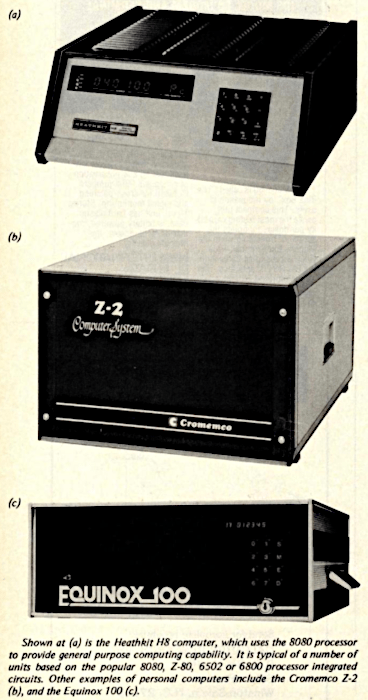
Equinox
Heath Co (H8)
IMSAI (8080)
MITS (Altair 8800b)
PolyMorphic
Processor Technology
Vector Graphic
There are more 8080 based personal computers than any other type.
Another consideration is the number of second sources available for the chip itself. As indicated earlier, the number of second sources is a clear evidence of the popularity of a particular microprocessor. Semiconductor manufacturers typically will not gear up to second source a device unless there is a large demand and an identifiable market for that device. A list of suppliers of the 8080 is given below.
Intel (the original 8080 design)
Advanced Micro Devices
Texas Instruments
National Semiconductor
NEC (Nippon Electric)
Siemens
Again, there are more second sources for the 8080 than for any other 8 bit microprocessor.
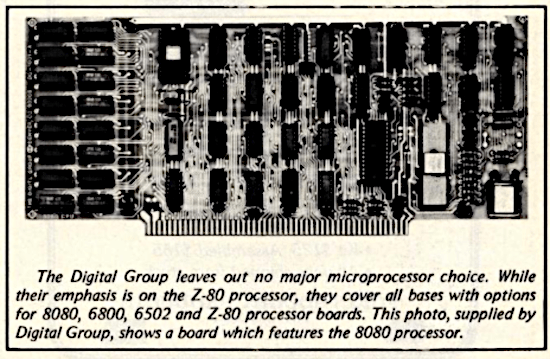
Another factor to consider is the bus design associated with the 8080 based microcomputers. The popular MITS Altair or S-100 bus is used by most of the manufacturers incorporating an 8080. The S-100 bus is in effect an 8080 bus. The signals defined on that bus are peculiar to the 8080. The S-100 bus over the past several years has become nearly a standard. While not an official standard, it does nevertheless provide the user with a wide choice of options and accessories for his 8080 based microcomputer. However, keep in mind that the Altair bus became a de facto standard by virtue of being the first widely sold design. Many manufacturers jumped on the Altair bus bandwagon when they started because it had a built-in marketing advantage; this helped snowball interest in the Altair bus. While the Altair (S-100) bus is certainly not an optimum choice, it is strong inducement to many individuals simply because so many people are using it and so many accessory products are available. By choosing an 8080 microprocessor you will no doubt at the same time be choosing an S-100 bus. That isn’t all bad. Keep in mind, however, that several 8080 designs on the market do not use the S-100 bus. Notably these are the Heathkit and Digital Group designs.
6800
The second most popular and widely used microprocessor is the Motorola 6800. It was announced almost a year after the 8080. Despite its time lag behind the 8080, the 6800 has come from behind to capture a rather large following. While it is still not as widely used as the 8080, it is a clear-cut second place with many followers and supporters.
The architecture of the 6800 is extremely simple. It is a classic, almost textbook-like design. Its instruction set is easy to learn and understand. And at the same time, it incorporates a variety of addressing modes. While it is slightly slower than designs like the 8080 or Z-80, the 6800 makes up the lack of speed in its superior instruction set, architecture and addressing modes.
A wide variety of software has been developed for the 6800. This software is widely available to most 6800 users.
The popularity of the 6800 can be illustrated by the number of hobby and personal computer manufacturers using the 6800. A probably incomplete list of these is given below.
Southwest Technical Products (SwTPC 6800)
Wavemate
Electronic Products Associates
MITS (Altair 680b)
Digital Group
Motorola
MSI
Heath Company
A list of second sources for the 6800 chip is given below.
Motorola
American Micro Systems Inc
Fairchild
Hitachi
Unlike the 8080, the 6800 does not appear at present to offer upwards compatibility. It is possible that a more powerful 6800 will be offered in the future. However, improved versions of the 6800 have been announced by Motorola. They include features such as on-chip clock and memory and higher speed versions. These improved versions will help lengthen the life of the 6800.
All in all, the 6800 is a well established microprocessor. You will certainly not go wrong in choosing this device in your microcomputer.
6502
The MOS Technology 6502 is essentially in third place in the hobby and personal computing field. This device is very similar to the 6800. There are a number of differences in that the 6502 does feature an on-chip clock, only one accumulator, and different indexed addressing modes. It is widely used in hobby and personal computers.
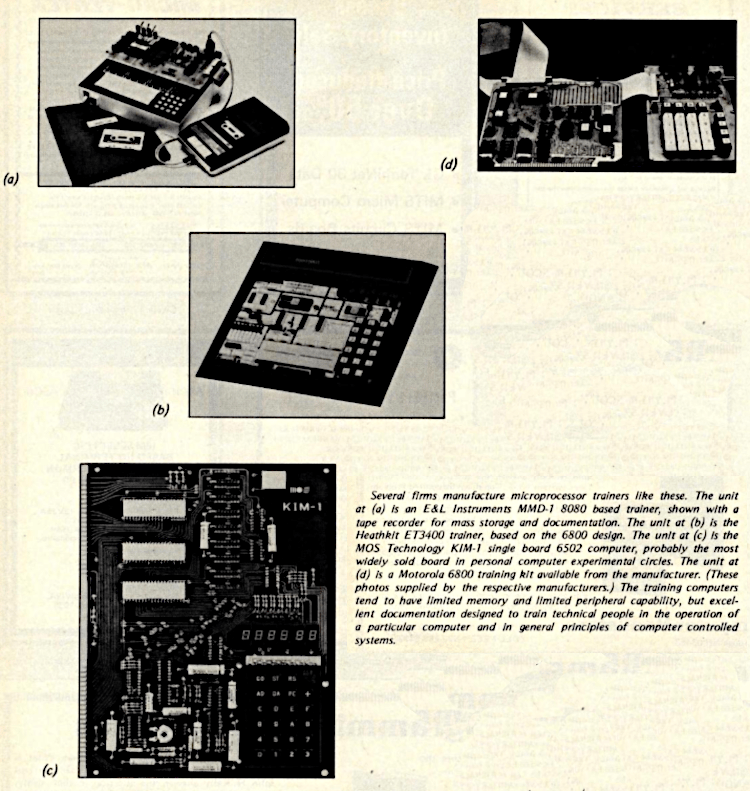
Due to the large number of KIM-1 computers in the field, the 6502 does have an enthusiastic following of users and an independent users’ publication.
Some of the personal computers using the 6502 are listed below.
Ohio Scientific Instruments
Apple Computer
MOS Technology (KIM-1)
Commodore PET
Microcomputer Associates JOLT
At the present time there are three sources for the 6502. These are MOS Technology, Synertek and Rockwell.
While the 6502 is way down the list in terms of popularity when compared with the 8080 and 6800, it is still a widely used device. Like the 6800, it is simple to learn and use. It is a practical choice for a personal computer.
Z-80
The Z-80 is one of the most popular and certainly the most talked about 8 bit microprocessor of 1976 and 1977. While it was introduced a number of years after the 8080 and 6800, it has managed to capture a significant portion of the microprocessor market. It has also been widely accepted in hobby and personal computing. Because it is essentially an improved and more powerful 8080, the Z-80 can be considered a part of the 8080 movement. Nevertheless, it deserves some attention on its own.
Some of the personal computers using the Z-80 are listed below.
Technical Design Labs
Cromemco
Digital Group
Radio Shack
The Z-80 also has two primary suppliers. These are ZiJog and Mostek.
Since the Z-80 will run most 8080 software, it is an excellent choice with respect to software. Besides the upwards compatibility and software factors, the Z-80 is also far more powerful. It runs at a higher speed, has a larger instruction set and more sophisticated addressing modes. The Z-80 is perhaps the best 8 bit microprocessor currently on the market.
Despite these advantages, the several Z-80 based processor boards developed as replacements for S-100 based microcomputers have not been all that popular. It is difficult for the owner of an 8080 based Altair bus microcomputer to justify a three or four hundred dollar expense simply to replace an 8080 processor with a Z-80. While you still maintain software compatibility, the Z-80 provides the additional benefits of greater computing power and speed. However, most hobbyists do not require the greater power and computing speed. The capabilities of the less powerful 8080 are more than adequate.
Choosing a microprocessor for a microcomputer design is an agonizing process. Yet once all of the factors are considered, the choice narrows down rather quickly. For a general purpose microcomputer, most designers circa 1975 to 1977 quickly identified the four choices given above. Choosing among them then becomes somewhat subjective. I was personally involved in making a decision for tiie microprocessor of the H8 Heathkit computer. When that choice was made in early 1975, the Z-80 was not available. The 6502 was a fairly new device and no second source was available. This narrowed the choice rather quickly to the 8080 and 6800. At that time the 6800 had not penetrated the 8 bit market as much as it has now. As a result, not as much software and documentation support were available. Because of this, the 8080 became the most obvious choice in our planning. Today, even with the greater penetration of the 6800 and the announcement of the 6502 and the Z-80, the choice of the 8080 for the Heathkit H8 was still a good one. The 8080 still has sufficient computing power for nearly any hobby and personal computing application. But today with more choices available, the 6800, Z-80 and 6502 are certainly viable alternatives. At some point in the decision making process, technical capabilities, specifications and other factors become meaningless and the choice is made strictly on subjective or emotional grounds.
What About the Others?
What about all those other microprocessors which are available to the hobby and personal computing user? Why shouldn’t a hobbyist consider these devices as well? The answer is a difficult one. First the other microprocessors are certainly capable of producing the same or even improved performance over the most popular devices in use. However, since they have not been widely adopted by microcomputer manufacturers, most of them are simply not available.
2650
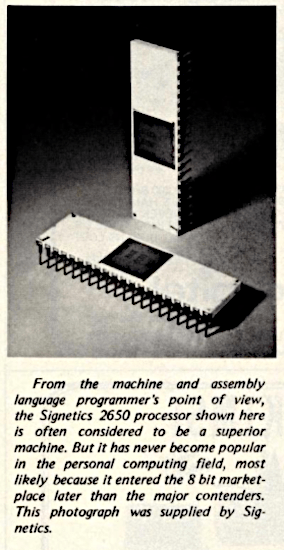
The Signetics 2650 is a good example. This device was announced well after the 8080 and 6800. However, it is a superior design in many ways. The 2650 is in effect more like a minicomputer than a microprocessor. It is extremely powerful in that it has a superior architecture and powerful instruction set. It also operates at a high rate of speed. Yet this device never really caught on. Today there are no widely used hobby and personal computers available using this device. As a result, there is limited software available for it. For the homebrew experimenter this device may be an excellent choice provided he is willing to develop his own hardware and support software.
SC/MP
The National SC/MP is another very interesting 8 bit microprocessor. It is perhaps one of the simplest and lowest cost devices available. Because it is so simple it does not offer the computing power of the other devices. Nevertheless, it is extremely easy to learn and use.
The main reason why the SC/MP has not been widely used is that again no hobby and personal computer manufacturer has selected it for its processor. National Semiconductor does provide several development kits that have found some interest in hobby and personal computing fields. In addition, National has developed a BASIC-like language called NIBL that was developed with the hobbyist in mind. For the homebrew enthusiast, the SC/MP is a good choice.
1802
The RCA 1802 is another interesting 8 bit microprocessor. This is a CMOS device which has extremely low power dissipation. Its low power dissipation has led to incorporation of the 1802 design into one well known experimenter’s project, the next series of AMSAT radio amateur satellites. Again, no hobby and personal computer manufacturer has selected this as the primary processor of a general purpose computer. The architecture and instruction set of the 1802 is peculiar and thus more difficult to use than other devices. Little or no software is available. Nevertheless, the 1802 is relatively easy to use and the homebrew hobbyist may find it a desirable choice. RCA makes several development kits that serve as a good starting point, one of which is intended as a low cost hobby computer.
F8/3870
The F8/3870 microprocessor is another widely used 8 bit microprocessor. The F8 is effectively a two chip microprocessor featuring a ROM on one chip. The 3870 is MOSTEK’s version of the Fairchild F8 in a single chip form. Neither of these devices has caught on for hobby and personal computer use. Only one hobby and personal computer manufacturer ever announced an F8 based machine and the company which manufactured it appears to be no longer in business. Both the F8 and the 3870 microprocessors were not designed for general purpose computer application. Instead, they were designed to be hardwired digital logic replacements. These are the microprocessors that were designed to be buried inside of equipment as controllers. As a result they make very poor choices as general purpose digital computers.
The same is true of the new Intel 8048/ 8748. Like the F8 and 3870, the 8048 incorporates all circuitry on one chip. This includes the processor, clock, both programmable and read only memory, as well as Input and output interfaces. The 8048 was designed as a hardwired logic replacement and not for general purpose digital computer application.
What About 12 and 16 Bit Microprocessors?
Without question the trend in microprocessor development is toward larger, more sophisticated designs. While most microprocessor activity is centered around 8 bit devices, there is clear evidence that single chip 16 bit microprocessors will eventually replace the 8 bit units. As semiconductor technology improves, it will be just as easy to manufacture a 16 bit microprocessor as it is an 8 bit device. When that time comes, the price differential will be minimal. As a result, most purchasers of new equipment will go to the more powerful 16 bit device over the 8 bit device, even though the computing power available is overkill for the application.
There are a number of 16 bit microcomputers and one 12 bit device now on the market. In terms of overall microprocessor usage, their popularity is small. But it is growing rapidly as more devices are developed. As these devices are incorporated in designs, the demand will go up and prices will decline.
Some of the manufacturers making a 16 bit microprocessor are given below.
National Semiconductor PACE, 8900
General Instrument 1600
Data General microNOVA
Digital Equipment Corp LSI-11
Texas Instruments 9900
Fairchild 9440
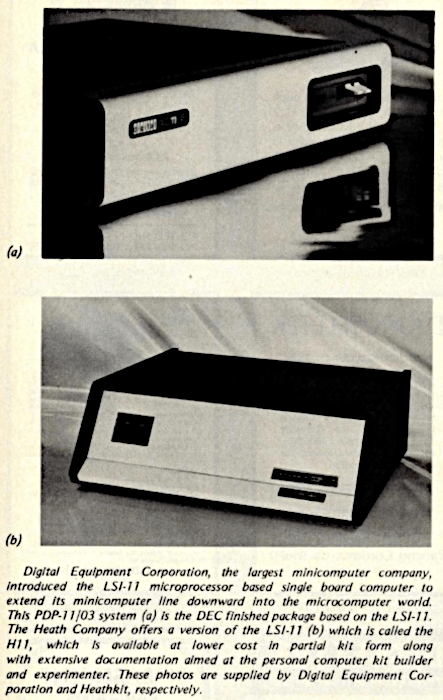
At present there are few hobby and personal computers based on 16 bit microprocessors. Notably those that are available are the Heathkit H11 which is based on the popular DEC LSI-1 1 and the Technico 9900, based on the TMS-9900 part from Texas Instruments.
The reason why 16 bit microprocessors haven’t caught on in personal computing is that they have not been widely adopted elsewhere. The price is significantly higher than 8 bit devices and little or no software is available. 16 bit microprocessors are far more powerful and can process data much faster than an 8 bit microprocessor. However, for most personal computing applications such power is not necessary.
At this time, the most widely used 16 bit microcomputer is the DEC LSI-11. This particular computer has a wide following among hobbyists because of the great DEC software base. It is an ideal choice for the advanced user.
None of the other available 16 bit microprocessors has yet caught on. The first 16 bit microprocessor available was National Semiconductor’s PACE. Despite its early lead, PACE never became popular.
The newer Texas Instruments 9900 16 bit microprocessor shows promise of becoming one of the more popular 16 bit microprocessors. This device may eventually become the 8080 of the 16 bit microprocessors. This device is gaining acceptance in many areas. It is a powerful, general purpose device. In addition, much of the software available for Texas Instruments minicomputer line is compatible and could possibly be converted in the future for use on this device. Finally, Texas Instruments is one of the largest and most aggressive semiconductor manufacturers. They have the manufacturing and marketing power to support and promote this device. Watch for it in future designs.
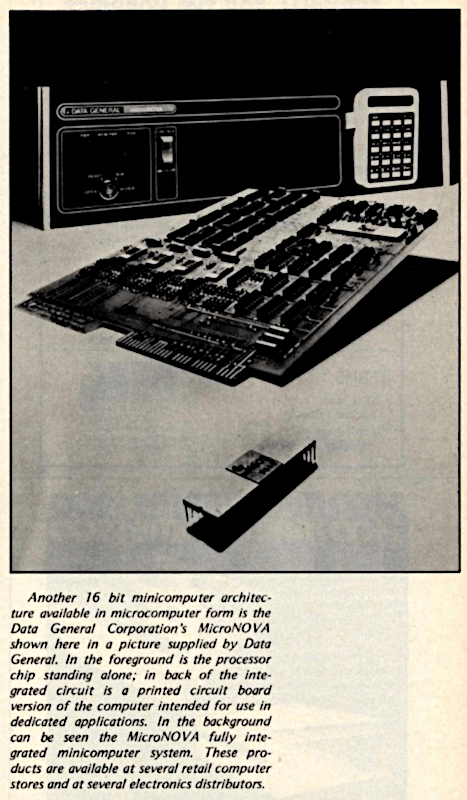
The Micro NOVA is another very powerful 16 bit microprocessor. It can effectively run all of the software available for the popular Data General NOVA line of minicomputers. However, this device like some of the others has not caught on. It is an expensive device and not widely available. While the architecture is straightforward and easy to learn and the Data General software base is tremendous, it is doubtful that Data General will promote this device for the personal computing market or make such software available at competitive prices. (However, Data General is promoting the Micro-NOVA through selected retail stores and electronics distributions. Fairchild’s 9440 MPU uses the Data General architecture and will run the software. Although it is expensive, someone may eventually use the 9440 in a personal computer.
The Intersil 6100 is a 12 bit CMOS microprocessor. Its claim to fame is that it has the architecture and instruction set of the famous DEC PDP-8/E minicomputer. It will also run software written for that machine. This gives the 6100 an excellent software base. But despite the software advantage the 6100 hasn’t caught on in personal computing. One reason is the high price associated with 6100 based computers. These include Intersil’s own Intercept series and a machine made by PCM. For the prices of these machines, a user can buy a used but real DEC PDP-8. In any case, the 6100 is a good chip with much potential.
Summary and Conclusion
The message in this article is relatively clear. If you are choosing a microcomputer for hobby and personal computer applications, your best choice lies in the 8080, Z-80, 6800 or 6502 based machines. This is the mainstream of personal computing. The 8080/Z-80 combination probably has the edge over all of these. The biggest question is who is going to make the 16 bit microprocessor. Will it be the new Intel 8086? or will Zilog’s Z8000 win? We will have to wait and see.
Finally, the message here is that “a processor alone does not a computer system make.” When it comes right down to it, the type of processor is almost irrelevant to the user who is programming in BASIC or PASCAL or some other high level language. Overall, it is the software that gets the job done. If you base your choice of a personal computer system on the availability of good system and application software, you will not go wrong, whatever low level machine architecture is used."