1984

A Good Buy on Unix

A Good Buy on UNIX

Special Report by Dean Hannotte

from the June 12, 1984 issue of PC Magazine

The Mark Williams Company’s COHERENT operating system is a rewritten version of the seventh edition of UNIX, with some extensions and enhancements. Regrettably, it has incoherencies.

The Mark Williams Company’s COHERENT operating system is a State-of-the-art microcomputer implementation of AT&T’s UNIX, without the state-of-the-art AT&T licensing fees. It is a completely rewritten version of the seventh edition of UNIX and includes some of its multi-user and multitasking abilities.

ARCNET: The Sleeping Giant

from the May/June 1984 issue of Two/Sisteen magazine

by Bro. Gary Eck, S.M.

Since its introduction, very little has been published to describe the use of ARCNET in concrete situations. This article describes the experiences of one ARCNET installation.

A giant of a computer system lies hidden in the Radio Shack product line. Based on the Model II and Model 12 workhorse computers, the ARCNET system allows for the linkingof many computers into a powerful, effective local area network system. Actually, ARCNET provides an efficient way of linking many more computers than XENIX.

Franklin Goes Chapter 11

from the August 1984 issue of Australian Micro Computerworld magazine

Franklin Computer, maker of Apple-compatible computers, has filed for reorganisation under Chapter 11 of the US Federal Bankruptcy Code.

In a prepared statement, Franklin president, Morton David said the company was experiencing falling sales and a “strain in financial resources’. To date, the company has about $US33.9 million in assets and $US22.8 million in liabilities, a spokesperson said.

The company owes significant sums to at least 20 unsecured creditors. Under Chapter 11, acompany is protected from its creditors while it reorganises, which usually takes several years. “We will spare no effort to turn Franklin around,” David said.

Keeping Unix in Its Place

An interview with Bob Marsh

from the December 1984 issue of Unix Review magazine

cover image

Many factors have contributed to the birth of a personal UNIX market but none has been more important than Onyx System’s decision to introduce a UNIX-based micro in 1980. Bob Marsh, now chairman of Plexus Computers, made that decision.

Chances are another company would have done the job sooner or later. But Marsh’s timing was critical. The success of the Onyx product showed not only that a UNIX micro port was technically feasible but commercially viable. The object lesson was not lost on OEMs , who were casting about at the time for alternatives to expensive minicomputer systems.

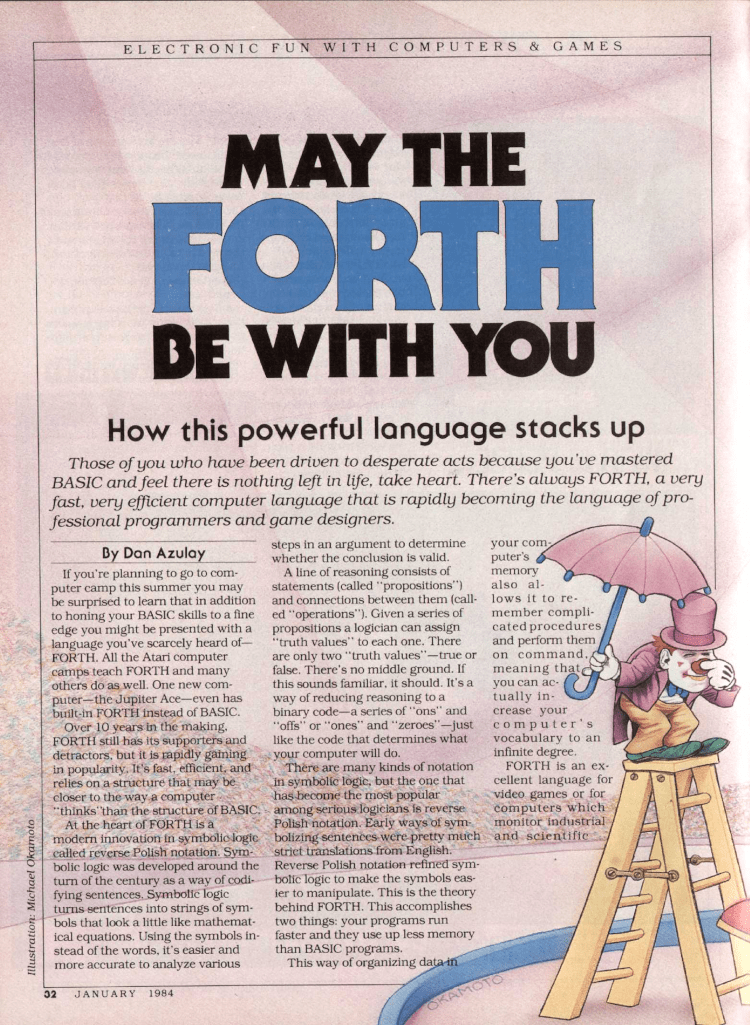
May the Forth Be With You

header

By Dan Azulay

from the January 1984 issue of Electronic Fun with Comouters and Games magazine

How this powerful language stacks up

Those of you who have been driven to desperate acts because you’ve mastered BASIC and feel there is nothing left in life, take heart There’s always FORTH, a very fast, very efficient computer language that is rapidly becoming the language of professional programmers and game designers.

If you’re planning to go to computer camp this summer you may be surprised to learn that in addition to honing your BASIC skills to a fine edge you might be presented with a language you’ve scarcely heard of—FORTH. All the Atari computer camps teach FORTH and many others do as well. One new computer—the Jupiter Ace— even has built-in FORTH Instead of BASIC.

The UNIX Horizon

from the December 11, 1984 issue of PC Magazine

UNIX fans have always believed their system was better than DOS. Now, with the release of the PC AT, many think UNIX will become the industry’s preferred operating system.

by Gig Graham

The software and hardware standards that have evolved from the remarkable success of the IBM PC and XT have stabilized the microcomputer industry, but at the expense of some sophistication in applications programs developed for the PC.

Wayne Wilson: the Australian Who Invented Concurrency

from the September 1984 issue of Australian Personal Computer magazine

Wayne Wilson, of Blacktown ts a little-known Australian hi-tech hero. He invented the concurrency concept that Australians now buy back from Microsoft and Digital Research. “We also had multi-user before Digital Research, and were the first to offer CP/M windowing" claims Wilson, and his partner, Roger Jones, who were also first to offer 8 and 16 bit running together. You’d think the world would beat a path to the door of AED (Acoustic Electronic Developments) unfashionably-located Blacktown Sydney factory door.